
Soybean Disease Identification Guide: What to Look for in Your Fields
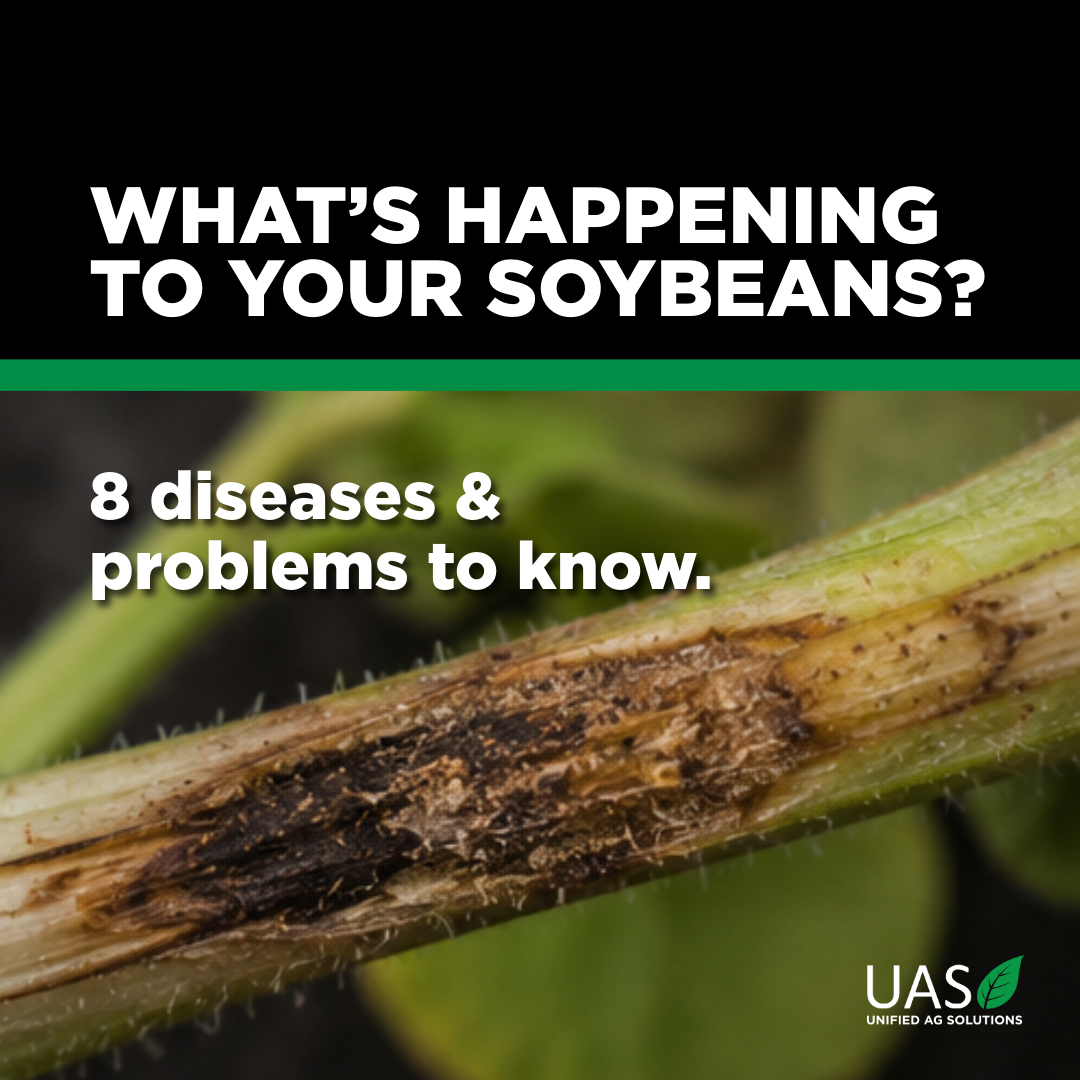
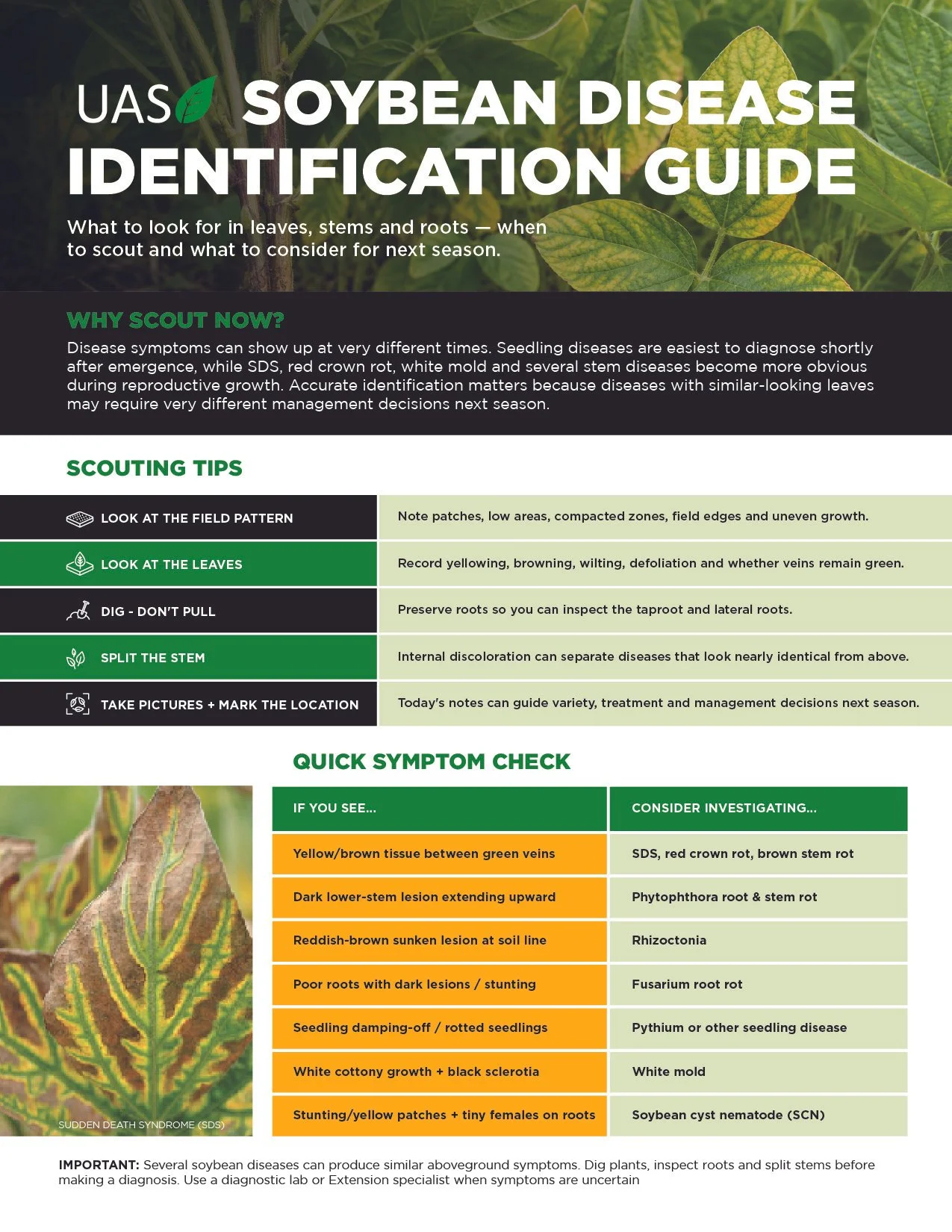
Soybean Disease
Identification Guide:
What to Look for in Your Fields
Yellowing leaves. Stunted plants. Brown stems. Rotting roots. Uneven patches across a soybean field. They're all signs that something isn't right—but identifying exactly what's affecting your soybeans isn't always easy.
Many common soybean diseases produce similar aboveground symptoms. Sudden Death Syndrome and Red Crown Rot, for example, can both produce interveinal yellowing and browning. Several seedling diseases can cause poor emergence and stunted plants. And Soybean Cyst Nematode can reduce yield without producing obvious aboveground symptoms at all.
That's why good soybean disease identification requires more than looking at the leaves. Dig plants. Inspect the roots. Split the stems. Look at the field pattern. And document what you're seeing.
What you learn while scouting this year's soybean crop can help you make better variety, seed treatment and management decisions for next season.
8 Soybean Diseases and Problems to Know
Here are eight important soybean diseases and pests to recognize while scouting.
1. Sudden Death Syndrome (SDS) in Soybeans
Sudden Death Syndrome (SDS) is an important soybean disease associated with Fusarium species.
When to Scout for SDS
Foliar symptoms commonly become noticeable after flowering, often around R3 and later, although infection can occur much earlier—particularly under cool, wet soil conditions.
What Does Sudden Death Syndrome Look Like?
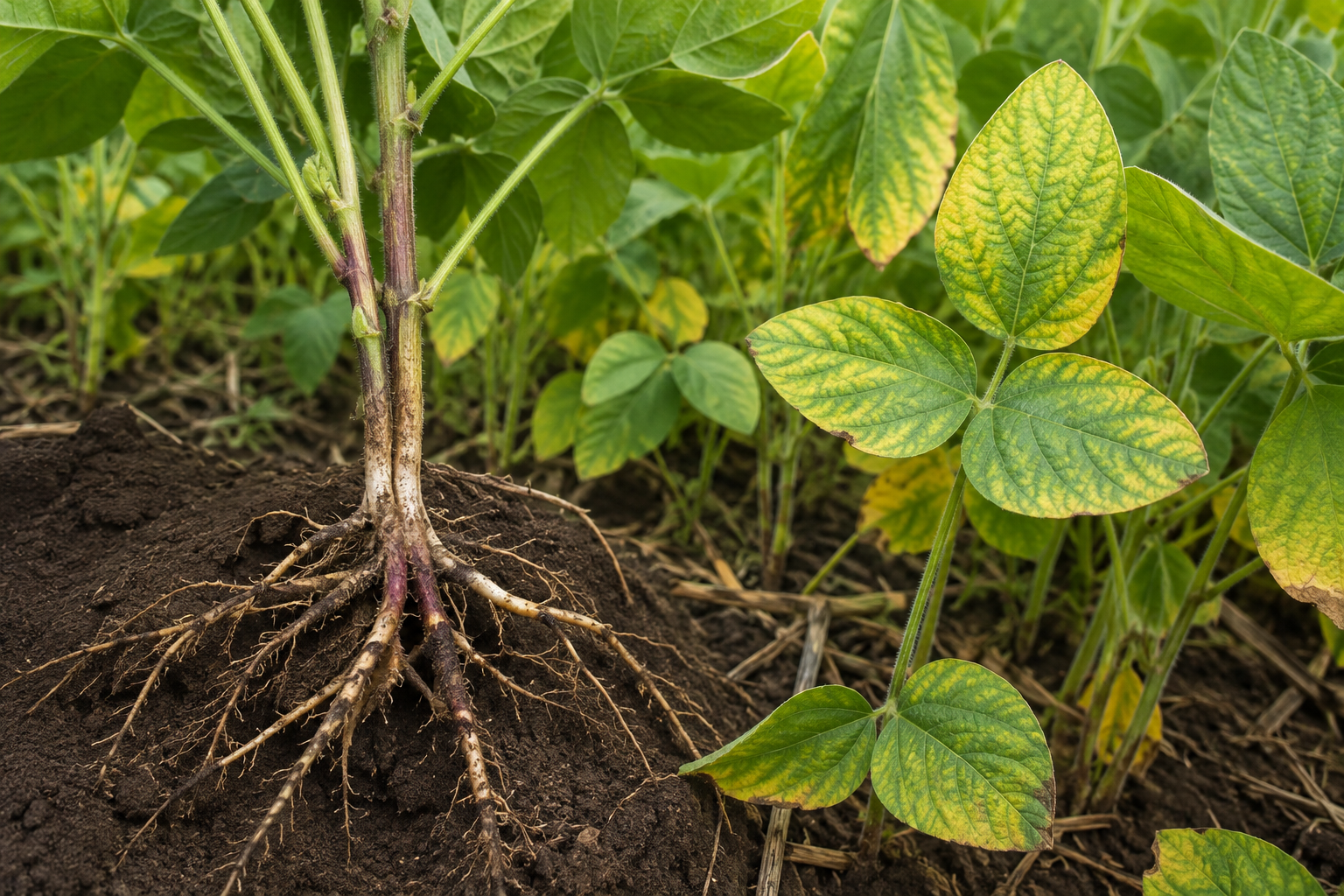
Leaves: Look for yellow areas developing between the leaf veins. These areas can eventually turn brown while the major veins remain green.
With severe SDS, leaves may drop prematurely while the petioles remain attached to the plant.
Roots: The root system may be reduced or deteriorated, with brown or dark-gray discoloration.
Stem: Split the stem. While lower tissue may show discoloration, the center pith in the upper stem generally remains white. Looking inside the stem can help distinguish SDS from other diseases with similar foliar symptoms.
What Should You Consider for Next Season?
If SDS is present, map affected areas and keep a record of field history.
Future management considerations may include:
Selecting soybean varieties with strong SDS tolerance or resistance
Managing Soybean Cyst Nematode where present
Addressing drainage or compaction problems
Reviewing planting conditions in high-risk fields
Evaluating labeled seed treatment options for SDS
2. Red Crown Rot in Soybeans
Red Crown Rot (RCR) can be particularly difficult to identify because its foliar symptoms may resemble SDS and other soybean diseases.
When to Scout for Red Crown Rot
RCR generally becomes easier to identify during reproductive growth as foliar symptoms develop.
What Does Red Crown Rot Look Like?
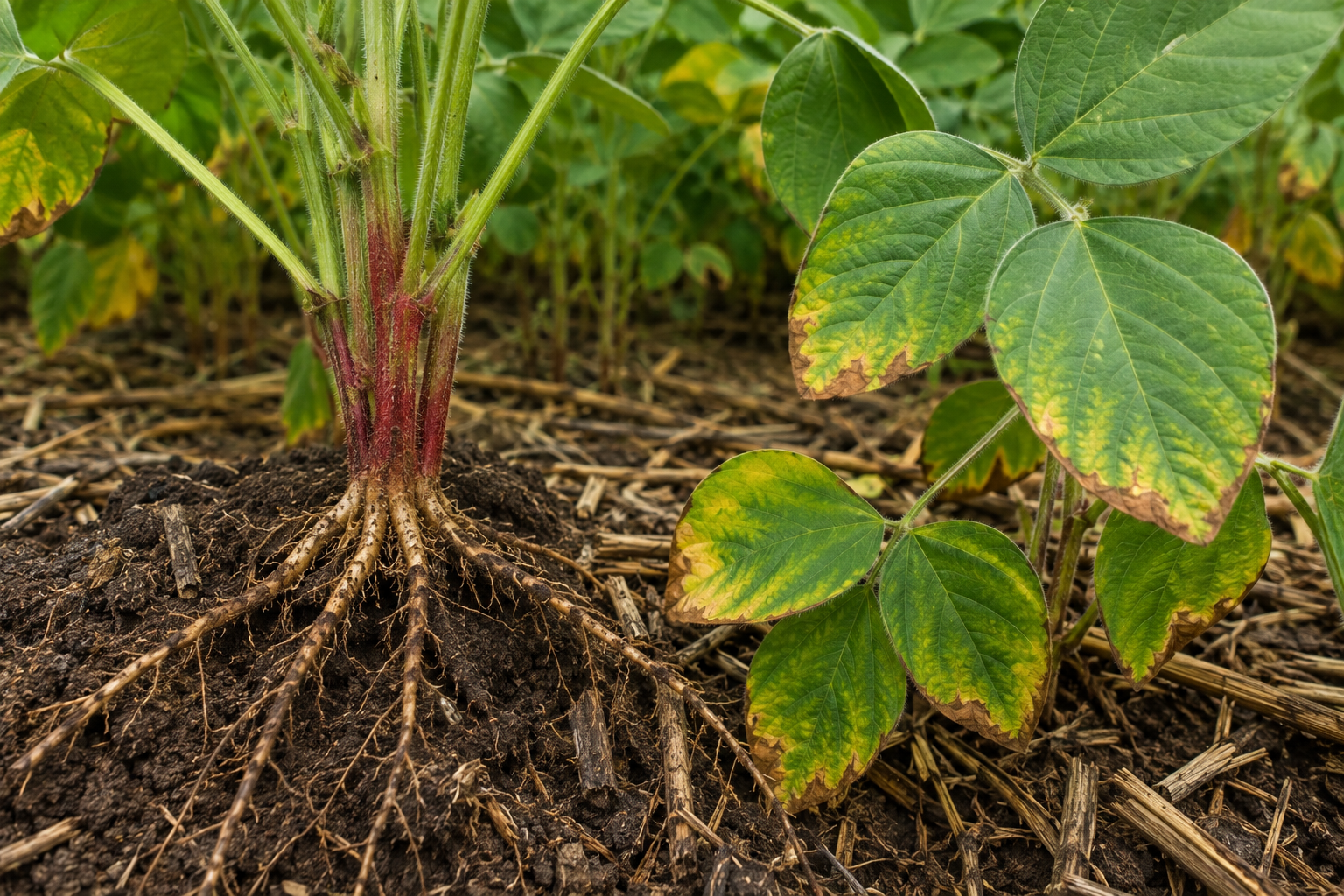
Leaves: Watch for interveinal yellowing and browning.
Roots: The root system may show signs of rot.
Stem and Crown: This is where closer inspection becomes especially important. Examine the plant around the soil line for reddish-brown discoloration.
Under humid conditions, small reddish-orange fungal structures may appear around the lower stem. The crown pith may also be gray or discolored.
What Should You Consider for Next Season?
Because RCR can resemble SDS from above, don't rely solely on leaf symptoms. Confirm suspicious plants, document where symptoms occurred and consider field disease history when evaluating varieties and management practices for future soybean crops.
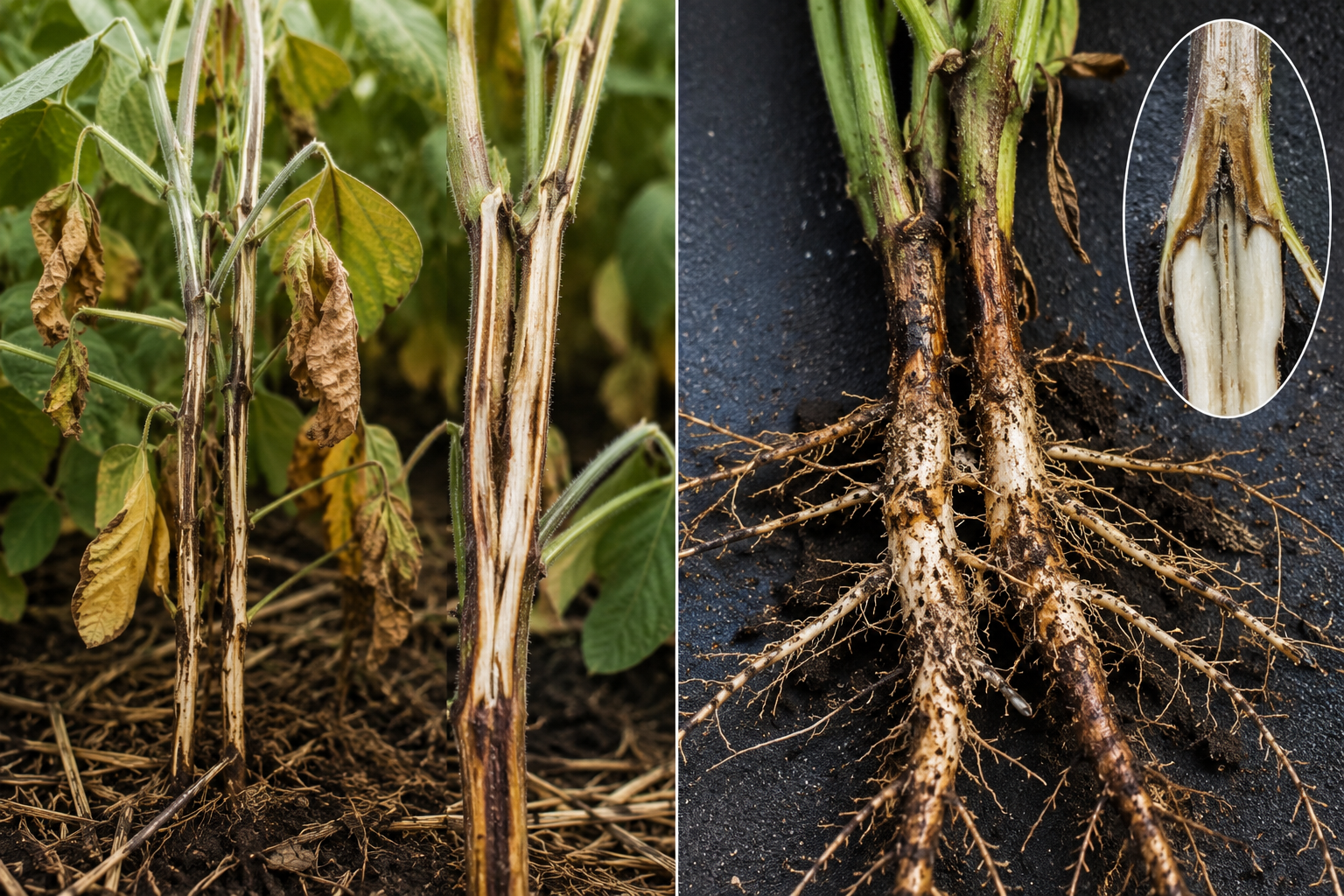
3. Phytophthora Root and Stem Rot in Soybeans
Phytophthora root and stem rot can affect soybeans from emergence through later stages of crop development. Wet conditions are an important clue when scouting for Phytophthora.
When to Scout for Phytophthora
Pay particular attention following saturated soil conditions and in poorly drained or compacted portions of the field.
What Does Phytophthora Look Like?
Leaves: Plants may yellow, wilt and eventually die. Leaves often remain attached to the plant.
Roots: Look for discolored or rotting roots.
Stem: One of the most recognizable symptoms is a dark-brown lesion beginning around the taproot or soil line and extending upward along the stem, potentially several nodes.
What Should You Consider for Next Season?
Future management considerations may include:
Resistant soybean varieties
Appropriate resistance genes and field tolerance
Improving field drainage
Addressing compaction
Labeled seed treatments with activity against Phytophthora
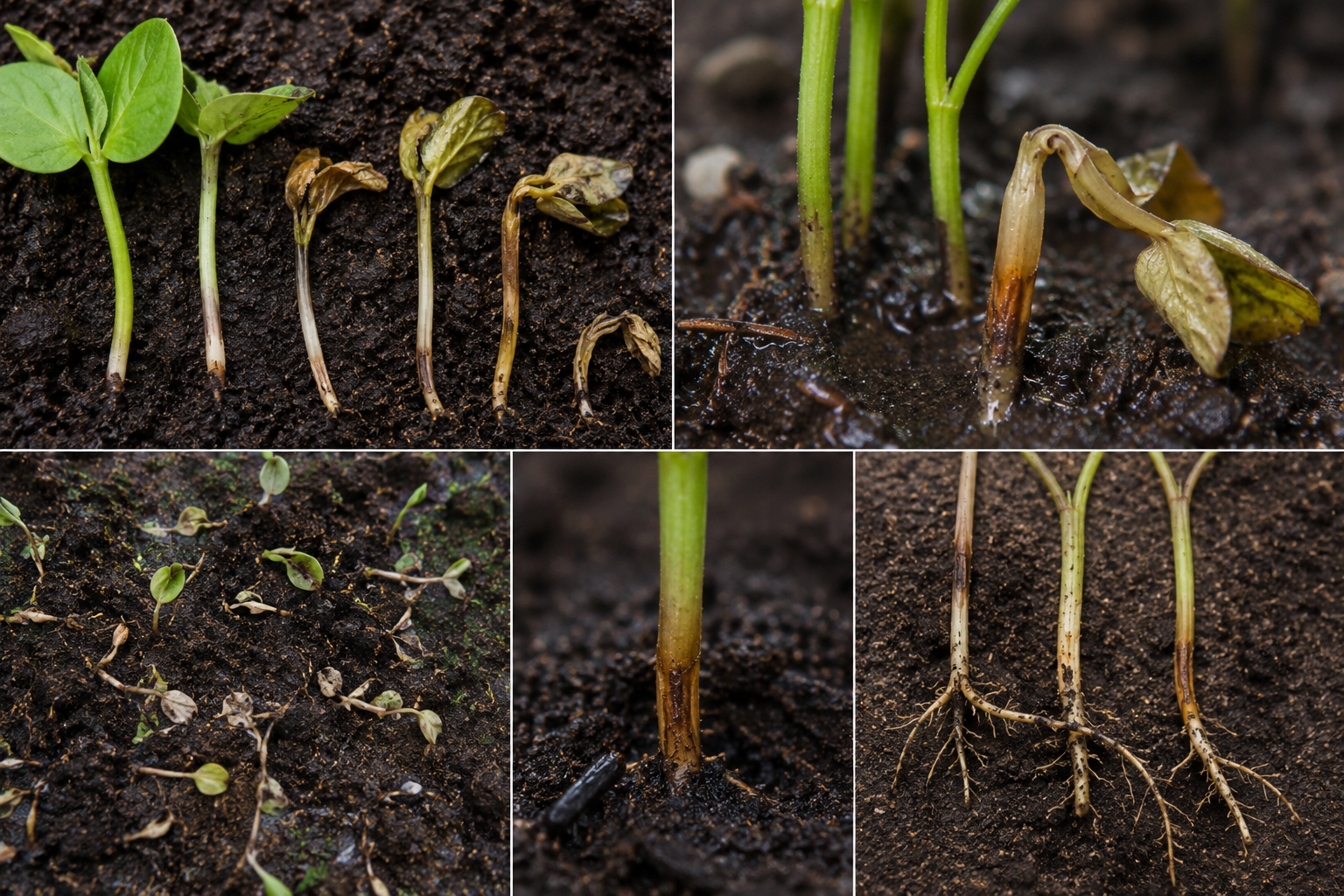
4. Pythium Seedling Blight in Soybeans
If you're seeing poor soybean emergence or seedlings dying shortly after emergence, Pythium is one potential cause worth investigating.
When to Scout for Pythium
Scout from planting through early vegetative growth, particularly following cool, wet or saturated soil conditions.
What Does Pythium Look Like?
Plants: Look for poor emergence, weak seedlings, yellowing and damping-off.
Some seedlings may die before they ever emerge.
Roots: Roots may appear soft, rotted or poorly developed.
Stem: Young root and hypocotyl tissue can appear water-soaked and decayed.
What Should You Consider for Next Season?
Document when and where the problem occurred.
Review:
Soil temperature and moisture
Planting date
Field drainage
Seed quality
Planting conditions
Labeled seed treatment fungicides with Pythium activity
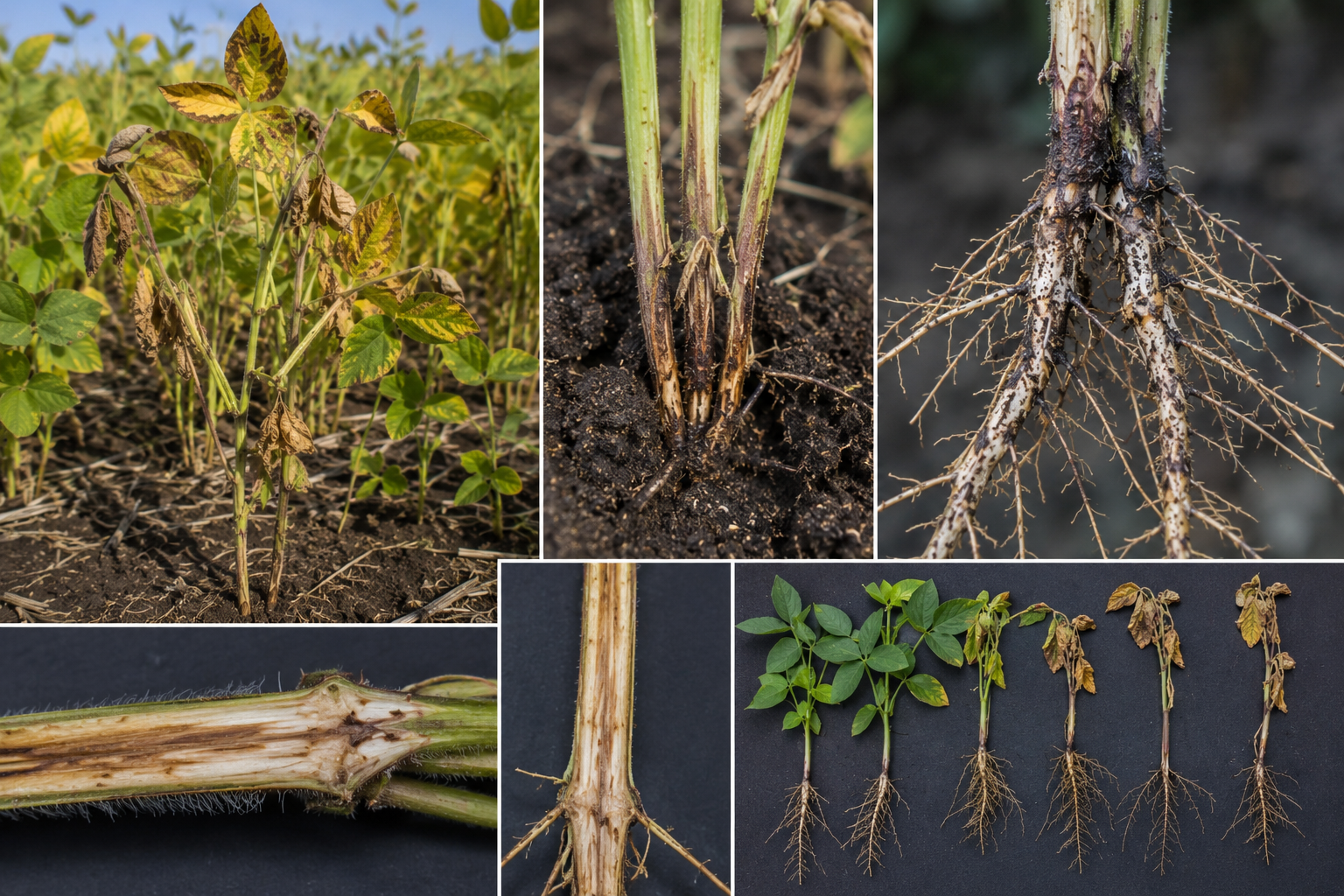
5. Fusarium Root Rot in Soybeans
Fusarium root rot can contribute to weak, uneven soybean stands and is often associated with stressed plants.
When to Scout for Fusarium Root Rot
Symptoms are particularly useful to scout during seedling and early vegetative growth, although root problems can persist later in the season.
What Does Fusarium Root Rot Look Like?
Plants: Seedlings may appear stunted, spindly or uneven. Severe infection can contribute to seedling death.
Roots: Look for poorly developed root systems with brown-to-black lesions and discoloration.
Stem: Depending on the specific Fusarium disease involved, internal tissue may also show discoloration.
Some symptoms aren't unique to Fusarium, so laboratory diagnosis may be necessary when identification is uncertain.
What Should You Consider for Next Season?
Look beyond the pathogen itself and identify stresses that may be contributing to disease.
These could include:
Soil compaction
Poor drainage
Root injury
Other unfavorable growing conditions
Variety selection, field management and labeled seed treatment options can then be evaluated as part of an integrated approach.
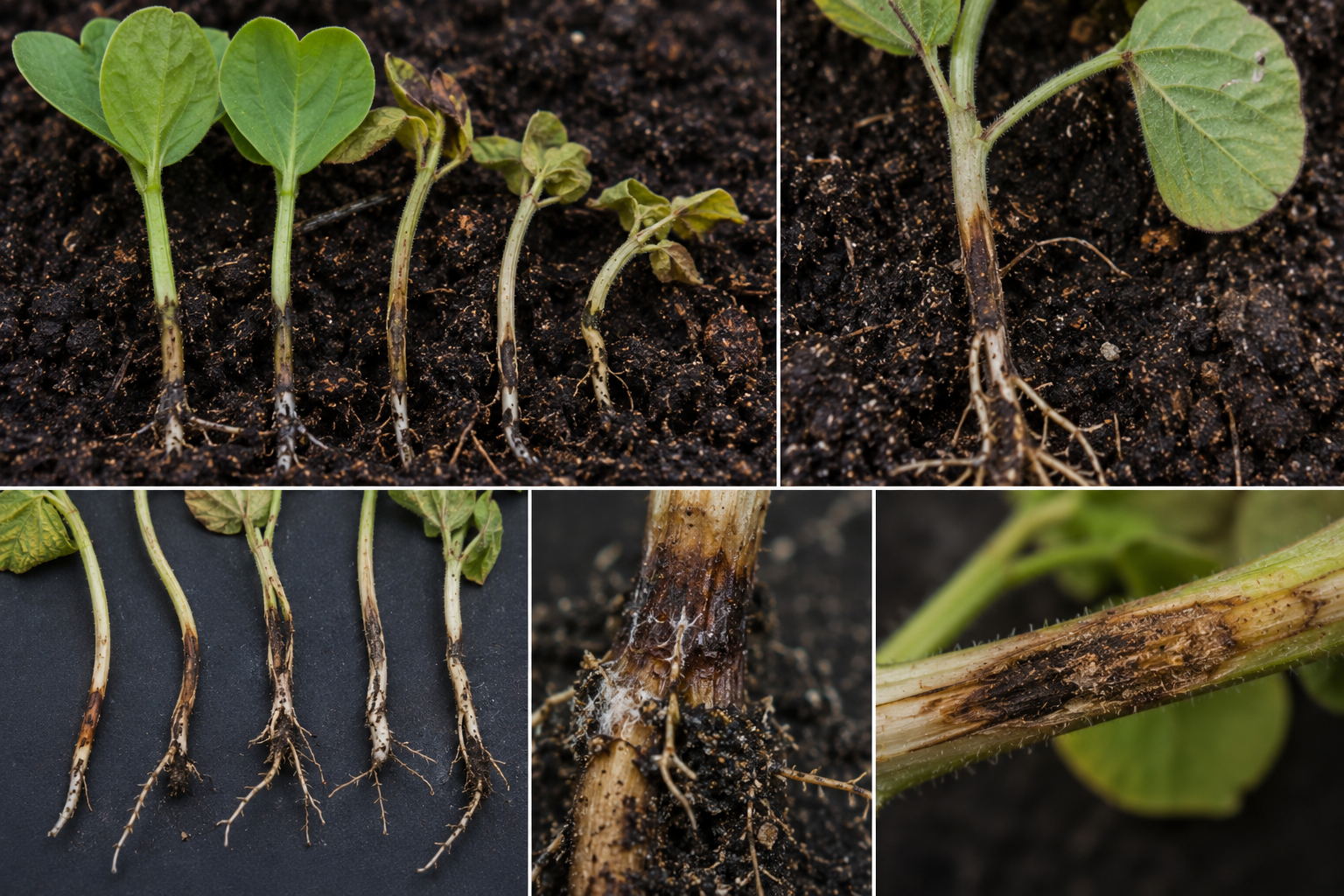
6. Rhizoctonia Seedling Blight in Soybeans
Rhizoctonia seedling blight is another disease to investigate when soybean seedlings are stunted, wilted or dying.
When to Scout for Rhizoctonia
Scout after emergence through early vegetative growth. Symptoms may appear in patches or along rows.
What Does Rhizoctonia Look Like?
Plants: Seedlings may become stunted, wilted or die.
Roots: Severe infection can result in reduced root systems.
Stem: One of the classic symptoms is a dry, sunken, reddish-brown lesion on the hypocotyl or lower stem near the soil line.
In severe cases, lesions can girdle the seedling.
What Should You Consider for Next Season?
Record where the disease occurred and the soil conditions at the time. Consider reducing seedling stress where possible and evaluating labeled seed treatment fungicides with Rhizoctonia activity when field history indicates elevated risk.
7. White Mold in Soybeans
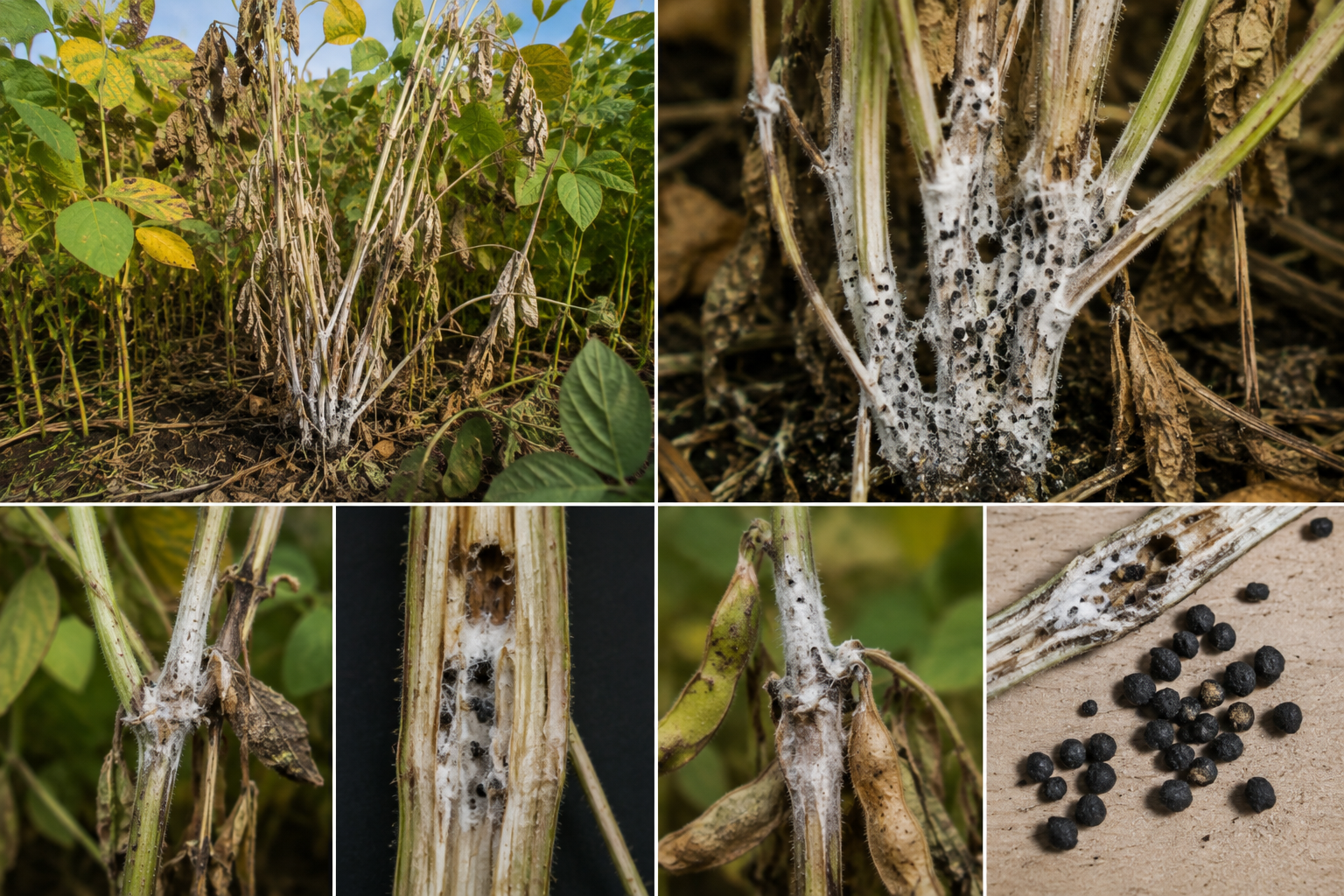
White mold, also known as Sclerotinia stem rot, tends to be associated with dense soybean canopies and cool, moist conditions.
When to Scout for White Mold
Disease risk is particularly important around flowering, although visible symptoms often become more noticeable later. Pay particular attention to thick canopy areas and fields with a history of white mold.
What Does White Mold Look Like?
Leaves and Plants: Individual plants may wilt and die, sometimes with leaves remaining attached.
Stem: Look for bleached or stringy stems and distinctive white, cottony fungal growth.
You may also find hard, black structures called sclerotia on or inside stems and pods. White mold frequently appears in patches rather than uniformly across a field.
What Should You Consider for Next Season?
Keep a record of affected areas and field history.
Future considerations can include:
Less-susceptible varieties
Plant population
Row spacing
Rotation with non-host crops
Irrigation and canopy management
Where fungicides are part of the management strategy, timing is important because applications are generally targeted around flowering rather than after obvious symptoms develop.
8. Soybean Cyst Nematode (SCN)
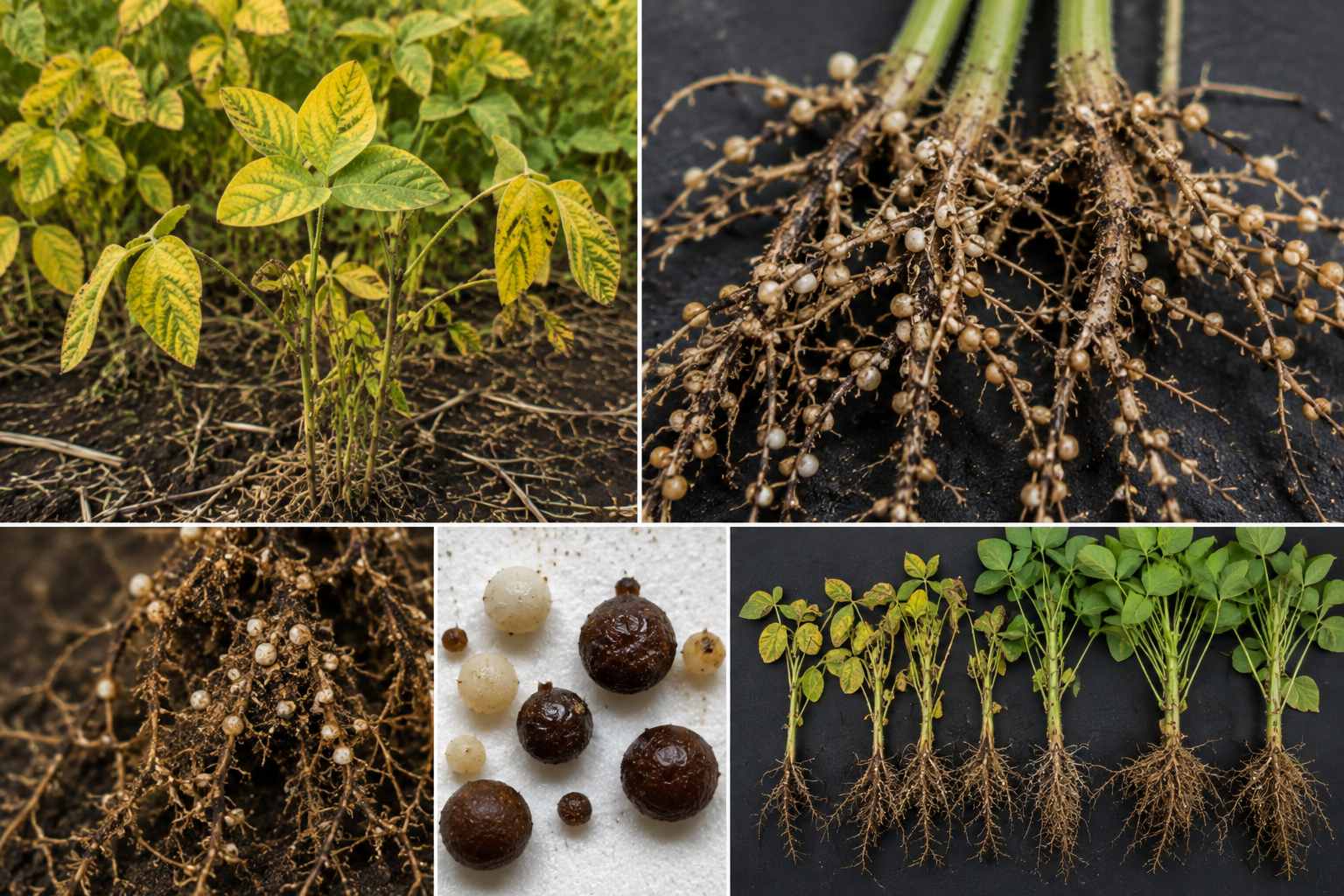
Soybean Cyst Nematode (SCN) deserves special attention because significant yield loss can occur without obvious aboveground symptoms. A field can look relatively normal and still have an SCN problem.
When Should You Scout for SCN?
Roots can be examined during the growing season, but soil testing is the best way to determine SCN population levels.
What Does Soybean Cyst Nematode Look Like?
Plants: Aboveground symptoms can include yellowing, stunting and early maturity. Symptoms may appear in patches—but visible symptoms aren't required for SCN to be present.
Roots: Carefully dig plants rather than pulling them.
Look closely for tiny white or yellow, lemon-shaped females attached to the roots. These are much smaller than soybean nodules.
What Should You Consider for Next Season?
If SCN is suspected, take soil samples to establish population levels.
Management considerations may include:
Rotating resistant soybean varieties
Rotating sources of SCN resistance
Using non-host crops
Monitoring SCN populations over time
Evaluating labeled nematode-management seed treatments
When Should You Scout Soybeans for Disease?
There isn't one ideal time to scout for every soybean disease.
Seedling diseases such as Pythium and Rhizoctonia are generally most noticeable shortly after emergence and during early vegetative growth.
Other diseases, including Sudden Death Syndrome, Red Crown Rot and White Mold, often become more obvious as soybeans enter reproductive growth.
The better approach is to scout throughout the growing season and pay particular attention when field conditions favor disease development.
When something doesn't look right, don't simply look at the plant from above.
How to Scout Soybeans for Disease
When scouting soybean fields, use the entire plant and surrounding field to help diagnose the problem.
1. Look at the Field Pattern
Before pulling individual plants, look across the field.
Are symptoms:
Scattered randomly?
Concentrated in patches?
Worse in low areas?
Appearing along rows?
Concentrated near field edges?
Associated with compacted or poorly drained areas?
The pattern can provide important clues about what's happening below ground.
2. Look at the Leaves
Watch for:
Yellowing
Brown or dead tissue
Wilting
Premature defoliation
Spots or lesions
Green veins surrounded by yellow or brown tissue
Don't diagnose the problem from leaf symptoms alone. Several soybean diseases can look remarkably similar aboveground.
3. Dig the Plant—Don't Pull It
If you're investigating a potential root disease, use a shovel. Pulling a soybean plant out of the ground can tear away small roots and remove some of the very symptoms you're trying to find. Preserve as much of the root system as possible and inspect the taproot and lateral roots for discoloration, lesions, rot and abnormal growth.
4. Split the Stem
A pocket knife can be one of your most useful soybean scouting tools. Cut the stem lengthwise and examine the internal tissue. The location and type of discoloration can help distinguish diseases that produce similar foliar symptoms.
5. Take Pictures and Mark the Location
Don't rely on remembering where you found something two months later. Take photos of the field pattern, leaves, roots and stems. Mark the affected area or save the location. Those observations become valuable when you're making seed and treatment decisions for the following season.
Don't Just Scout This Year's Crop. Scout for Next Year's Decisions.
Finding a problem before harvest doesn't always mean there's something you can do about it this year. But that doesn't make scouting any less valuable. The disease pressure you identify this season can help build a better soybean seed treatment and management program for next season.
When you find a problem: Document it. Take pictures. Mark the field location. Dig roots. Split stems. And confirm the diagnosis when necessary.
Then use what you learned when evaluating next year's varieties, seed treatments, biologicals, planting decisions and field management practices.
Several soybean diseases can produce very similar symptoms, so don't make a management decision based on leaf appearance alone. When you're uncertain, consider submitting samples to a diagnostic laboratory or working with an agronomist or Extension specialist to confirm the cause.
Build Your Next Soybean Treatment Program with UAS
Seed treatment isn't about throwing more products on the seed. It's about understanding what you're trying to protect against and selecting the right products for the field.
Unified Ag Solutions can help you evaluate your current treatment program, understand the options available and build a soybean seed treatment package around the needs of your operation.
Products. Equipment. Expertise. Support. Everything Seed Treatment.